Last updated: November 25, 2026. For general education only, not medical advice.
A good nighttime routine does not need many steps or expensive products. Dermatology guidance supports a short routine: clean the skin gently, moisturize, and use a retinoid if it suits you. This guide explains what is supported by evidence, what is not, and why sleep itself matters for your skin.
Key takeaways
- A simple routine of gentle cleansing and moisturizing covers the basics. Extra products such as serums and eye creams are optional [1][2].
- Moisturizer works best when applied within a few minutes of washing, while the skin is still slightly damp [1].
- Retinoids are normally used at night. Start slowly, perhaps every other night, and use sunscreen the next day [2][3].
- Sunscreen is a daytime step. Antioxidant creams are not a substitute for it.
- Poor sleep is linked to weaker skin barrier recovery and more signs of aging, although the research is limited [4].
A simple routine
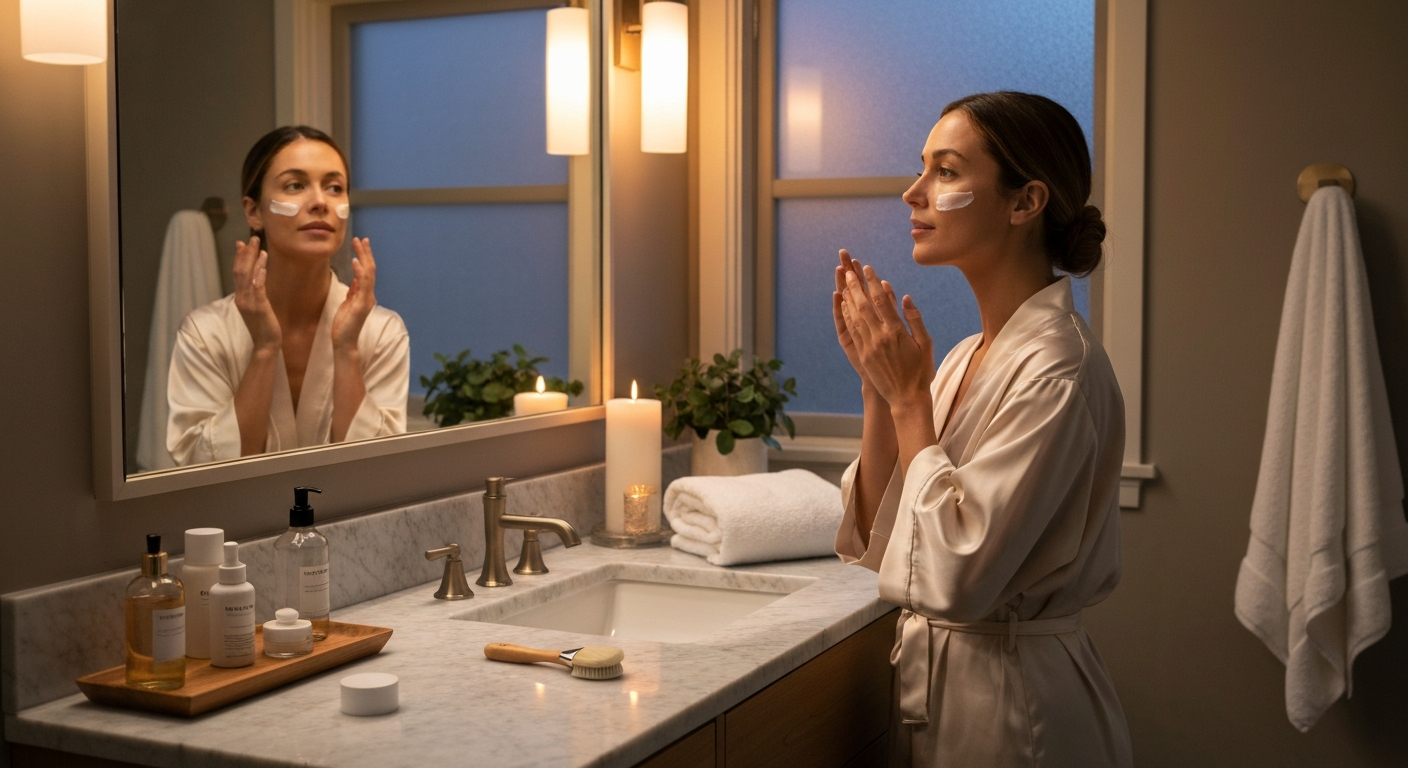
- Remove makeup and cleanse gently. Use warm, not hot, water and a gentle, fragrance-free cleanser. Hot water and harsh soaps strip skin’s natural oils [1]. Pat or blot skin dry rather than rubbing [5].
- Apply any treatment product. If you use a retinoid, evening is the usual time. Start with the least intense formula, apply it every other night at first, and increase slowly [2]. If you also use other active ingredients such as acids, alternate them on different nights [6].
- Moisturize. Apply moisturizer within a few minutes of washing to trap the water already in your skin. Creams and ointments add more moisture than lotions, and fragrance-free formulas are gentler [1].
That is enough for most people. Eye creams, serums and overnight masks are optional extras. We did not find reliable evidence that serums “penetrate deeper” or that a specific number of products works best, and claims such as “skin repairs itself most actively at night” or “a 28-day skin cycle” are oversimplifications.
Retinoids at night
Retinoids, which include over-the-counter retinol and prescription tretinoin, can irritate skin, especially at the beginning. Redness, itching, burning and flaking are common, and retinoids can make skin more sensitive to the sun, so sunscreen is important during the day [3]. Retinoids should be avoided during pregnancy and breastfeeding, and you should talk to your healthcare provider if you are pregnant or planning to be [7]. See our separate beginner’s guide to retinol.
What about sunscreen at night?
You do not need sunscreen at night. The articles claiming that “antioxidant creams can replace sunscreen” are wrong, since antioxidant products are not a substitute for broad-spectrum sunscreen of SPF 30 or higher during the day [8].
Sleep and your skin
A study of 60 women aged 30 to 49 found that those with poor-quality sleep (about 5 hours or less) had more signs of intrinsic skin aging than good sleepers (7 to 9 hours). Their skin barrier recovery was about 30% lower 72 hours after the barrier was disrupted, and they recovered more slowly from sunburn-like redness after UV exposure [4]. The study was small, showed association rather than cause, and was supported by a cosmetics company [9]. Still, regular, adequate sleep is a healthy habit that no skincare product replaces.
Common mistakes
- Using too many new products at once. Introduce one at a time so you can tell what irritates.
- Going to bed with makeup on. Wash it off every night.
- Using hot water, harsh cleansers or products with fragrance if your skin is dry or sensitive [1].
- Applying retinoids too often too soon.
Frequently asked questions
How long should a night routine take?
A basic routine takes a few minutes. There is no evidence that longer routines work better.
Should I use the same moisturizer day and night?
You can, if it suits your skin. Some people prefer a richer cream at night, but there is no proven need for a separate “night cream.”
How long until I see results?
Moisturizers help comfort quickly, while retinoids can take up to about 12 weeks to improve fine lines and dark spots [10].
Can I use retinol every night?
Beginners should start slowly, and build up as skin adjusts [2][3].
Conclusion
An effective night routine can be as simple as gentle cleansing and moisturizing, with a retinoid added if recommended. Combined with daily sunscreen in the morning and enough sleep, this covers most of what the evidence supports. If you have acne, eczema or other skin concerns, ask a dermatologist for a routine tailored to you.
References
- American Academy of Dermatology. Dermatologists’ top tips for relieving dry skin. https://aad.org/public/everyday-care/skin-care-basics/dry/dermatologists-tips-relieve-dry-skin
- American Academy of Dermatology. Retinoid or retinol? https://aad.org/public/everyday-care/skin-care-secrets/anti-aging/retinoid-retinol
- UNC Health. Frequently asked questions about retinoids. https://healthtalk.unchealthcare.org/frequently-asked-questions-about-retinoids/
- Oyetakin-White P, Suggs A, Koo B, et al. Does poor sleep quality affect skin ageing? Clin Exp Dermatol. 2015;40(1):17-22. https://pubmed.ncbi.nlm.nih.gov/25266053/
- Mass General Brigham. Taking care of dry or sensitive skin. https://massgeneral.org/condition/dry-skin
- How often should you use retinol? Here’s what dermatologists say. https://www.aol.com/lifestyle/often-retinol-heres-dermatologists-204247049.html
- Cleveland Clinic. Retinol: what it is, benefits and side effects. https://my.clevelandclinic.org/health/treatments/23293-Retinol
- American Academy of Dermatology. Sunscreen FAQs. https://www.aad.org/media/stats-sunscreen
- HealthDay. Sleep quality impacts skin function, aging in women (2013). https://medicalxpress.com/news/2013-08-iid-quality-impacts-skin-function.amp
- Should you use retinol and retinoids? (dermatologist interview). https://www.aol.com/retinol-retinoids-143810962.html
Medical disclaimer
This article is for informational purposes only and does not replace professional medical advice, diagnosis or treatment. Always consult a qualified healthcare provider or dermatologist before using retinoids or other active ingredients, particularly if you are pregnant, breastfeeding, taking medication or have a skin condition.