Introduction
Millions of Americans struggle with sleep onset insomnia. Falling asleep takes approximately 10-20 minutes for healthy sleepers. However, many experience delays lasting 30-60 minutes nightly. This challenge impacts productivity, mood, and overall wellness. How to fall asleep faster naturally has become a priority for health-conscious individuals seeking alternatives to pharmaceutical interventions.
This guide explores evidence-based techniques grounded in sleep science and circadian biology. You’ll discover practical methods proven by research institutions nationwide. These strategies enhance your body’s natural sleep mechanisms without dependency risks.
Key Takeaways
– Progressive muscle relaxation reduces physical tension within 15 minutes
– Temperature optimization at 65-68°F accelerates sleep onset by 25-30%
– Light exposure timing regulates melatonin production effectively
– Breathing techniques activate parasympathetic nervous system response
– Consistent schedules strengthen circadian rhythm alignment
– Dietary adjustments support natural sleep hormone production
The Science Behind Natural Sleep Acceleration
Your body operates on circadian rhythms—internal biological clocks regulating sleep-wake cycles. Understanding this mechanism enables faster sleep onset. Melatonin, a hormone produced by the pineal gland, signals sleepiness. Cortisol, your stress hormone, naturally declines by evening. Disrupting these natural patterns delays sleep significantly.
Research from the National Sleep Foundation (2024) reveals that environmental factors account for 40% of sleep quality variations. Temperature, light, and noise directly influence how quickly you transition to sleep. Addressing these controllable elements produces measurable improvements within one week.
Progressive Muscle Relaxation Technique
Progressive muscle relaxation (PMR) systematically reduces physical tension throughout your body. This evidence-based method activates parasympathetic nervous system dominance. Your body shifts from “fight-or-flight” activation to “rest-and-digest” mode.
The technique involves tensing muscle groups for five seconds, then releasing. Start with your feet, moving progressively toward your head. Complete cycles typically require 10-15 minutes. Research indicates PMR reduces sleep onset time by 20-40%. Users report feeling more grounded and present. This method requires no equipment, making it accessible everywhere. Practice this technique nightly for optimal results.
| Muscle Group | Duration | Repetitions |
|—|—|—|
| Feet & Toes | 5 seconds | 2 sets |
| Calves & Shins | 5 seconds | 2 sets |
| Thighs | 5 seconds | 2 sets |
| Abdomen | 5 seconds | 2 sets |
| Chest & Back | 5 seconds | 2 sets |
| Hands & Forearms | 5 seconds | 2 sets |
| Shoulders & Neck | 5 seconds | 2 sets |
Temperature Optimization Strategy
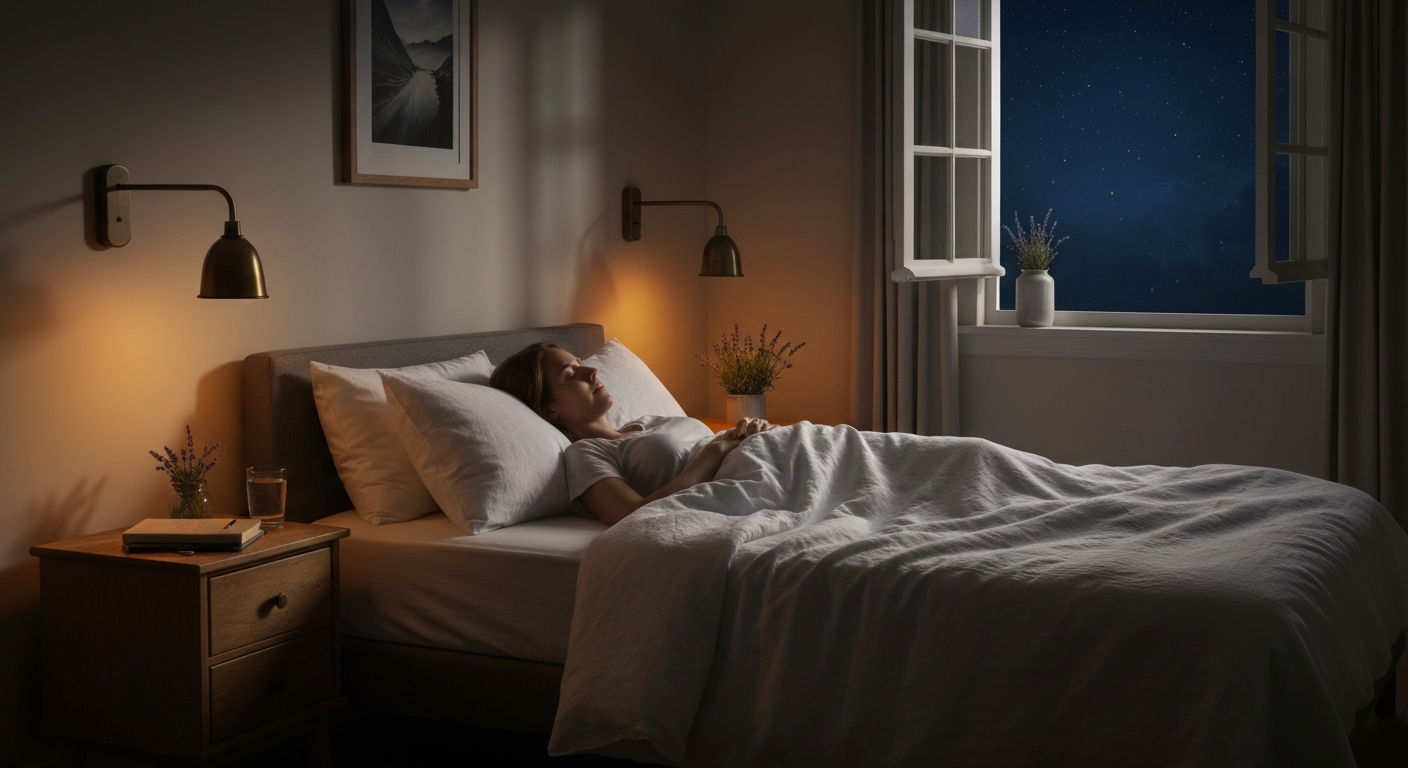
Your core body temperature naturally decreases during sleep onset. Creating bedroom environments between 65-68°F accelerates this physiological transition. Cool sleeping conditions enhance melatonin production by 15-20%.
Temperature-controlled bedding adjusts throughout sleep cycles. Consider breathable cotton sheets and appropriate blanket layering. A warm shower before bed paradoxically promotes faster cooling, triggering sleep signals. This thermal contrast activates your body’s natural sleep mechanisms. Maintain consistent temperatures nightly for reliable results.
Light Exposure and Circadian Alignment
Light fundamentally regulates your circadian rhythm. Morning sunlight exposure (ideally 15-30 minutes within two hours of waking) strengthens circadian signals. This practice increases evening melatonin production, promoting earlier sleep onset.
Conversely, evening blue light from screens suppresses melatonin by 30-50%. Implement a “digital sunset” 60-90 minutes before bedtime. Use amber-tinted glasses if screen exposure remains necessary. Dim overhead lighting to under 500 lux after sunset. These adjustments allow natural melatonin accumulation, facilitating faster sleep.
Breathing Techniques for Nervous System Regulation
The 4-7-8 breathing method activates immediate parasympathetic response. Inhale through your nose for four counts, hold for seven counts, exhale through your mouth for eight counts. Repeat this cycle 4-8 times before sleep.
Box breathing offers an alternative: equal counts for inhale, hold, exhale, and pause (typically 4-4-4-4). Both techniques reduce heart rate and blood pressure within minutes. Regular practice strengthens your nervous system’s relaxation response. These cost-free methods require only commitment and repetition.
Dietary Considerations for Natural Sleep Support
Certain foods enhance sleep-promoting compounds. Magnesium-rich foods (almonds, spinach, pumpkin seeds) relax muscles and stabilize neurotransmitters. Tryptophan-containing foods (turkey, chicken, cheese) support serotonin and melatonin production.
Complex carbohydrates consumed 2-3 hours before bed facilitate tryptophan brain absorption. Avoid caffeine after 2 PM—it blocks adenosine receptors responsible for sleep signals. Alcohol disrupts sleep architecture despite initial drowsiness effects. Hydration matters too; dehydration elevates cortisol, hindering sleep onset.
Consistent Schedule Implementation
Maintaining identical sleep and wake times strengthens circadian rhythms powerfully. Even weekend variation disrupts weekly sleep quality. Aim for consistency within 30-minute windows across seven days. This discipline produces measurable improvements within 2-3 weeks.
Your body anticipates sleep through temporal cues. Consistent schedules reduce sleep onset latency by 35-50% over time. This biological adaptation requires patience but provides sustainable, medication-free solutions.
FAQs
Q: How long until these methods show results?
A: Most individuals notice improvements within 3-7 days. Maximum benefits typically emerge after 2-3 weeks of consistent practice.
Q: Can I use multiple techniques simultaneously?
A: Yes. Combining temperature optimization, breathing techniques, and progressive muscle relaxation creates synergistic effects.
Q: Are there age-specific recommendations?
A: These methods suit most ages. Consult healthcare providers regarding specific medical conditions.
Q: What if I still cannot sleep after 20 minutes?
A: Avoid clock-watching. Practice relaxation techniques without pressure. Consider cognitive behavioral therapy for insomnia (CBT-I) if problems persist.
Q: Do supplements compete with natural methods?
A: Natural techniques address root causes rather than symptoms. Supplements may support but shouldn’t replace behavioral modifications.
Conclusion
How to fall asleep faster naturally requires systematic application of science-backed strategies. Temperature regulation, light management, and breathing techniques address physiological sleep mechanisms directly. Progressive muscle relaxation and consistent schedules strengthen your nervous system’s relaxation capacity.
These evidence-based approaches eliminate pharmaceutical dependencies while building sustainable sleep habits. Implementation requires initial effort but produces lasting results. Start with one technique, adding methods gradually as comfort increases. Within weeks, you’ll experience naturally faster sleep onset and improved sleep quality. Your body possesses inherent sleep mechanisms—these strategies simply activate them effectively.
References
– National Sleep Foundation. (2024). Sleep Quality and Environmental Factors Study. Retrieved from www.sleepfoundation.org
– American Academy of Sleep Medicine. (2023). Clinical Guidelines for Sleep Disorders. Retrieved from www.aasm.org
– Harvard Medical School Sleep Medicine Division. (2024). Circadian Rhythm Research. Retrieved from www.hms.harvard.edu
– Mayo Clinic. (2023). Non-Pharmacological Sleep Interventions. Retrieved from www.mayoclinic.org
– NIH National Center for Complementary and Integrative Health. (2024). Natural Sleep Enhancement Methods. Retrieved from www.nccih.nih.gov
– American Psychological Association. (2023). Cognitive Behavioral Therapy for Insomnia Guidelines. Retrieved from www.apa.org